全球首创糖免疫检查点疗法,复宏汉霖HLX316在中国完成首例患者给药
2026年5月22日,复宏汉霖(2696.HK)宣布,公司潜在同类首创(first-in-class,FIC)靶向B7-H3的唾液酸酶融合蛋白HLX316在晚期或转移性实体瘤患者中开展的I期临床研究(HLX316-FIH101)已在中国完成中国患者给药(First Patient Dosed,FPD)。该进展标志着HLX316正式进入临床研究阶段,旨于评估其在晚期/转移性实体瘤患者中的安全性、耐受性及初步疗效。
直击双重机制,破局免疫逃逸
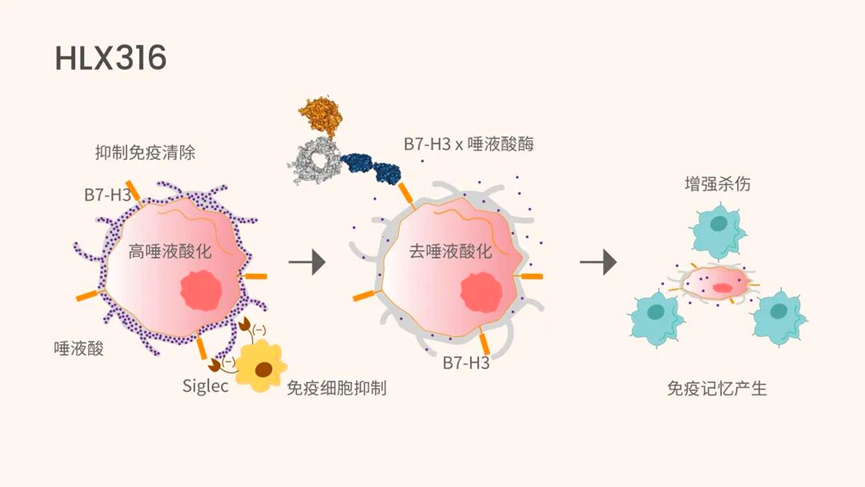
HLX316是一款靶向B7同源物3(B7-H3/CD276)的人唾液酸酶融合蛋白。HLX316针对癌症中两种关键的免疫逃逸途径,即B7-H3过表达和肿瘤高唾液酸化。B7-H3是一种免疫检查点蛋白,在肺癌、乳腺癌、结直肠癌、胰腺癌、前列腺癌和卵巢癌等多种实体肿瘤中过表达,其与肿瘤进展和预后不良相关,但在正常组织中的表达水平很低。肿瘤高唾液酸化可以衔接白细胞上的抑制性Siglec受体,从而削弱先天性和适应性免疫效应功能。HLX316通过酶促作用精准去除末端唾液酸,并在B7-H3阳性肿瘤细胞中实现活性倍增,从而解除糖免疫检查点抑制,恢复肿瘤微环境内的先天性和适应性免疫介导的抗肿瘤功能。
通过靶向表达B7-H3的肿瘤细胞及其微环境发挥唾液酸酶活性,HLX316具备同时缓解蛋白和聚糖介导的免疫抑制的潜力,有望拓宽免疫治疗在实体瘤中的应用范围,突破现有治疗方案局限。临床前研究显示,HLX316对肿瘤细胞具有强效的B7-H3定向去唾液酸化作用,且具有良好的耐受性。
驱动体系化创新,构建多元管线
HLX316为复宏汉霖与Palleon战略合作开展的创新项目之一。Palleon基于2022年诺贝尔化学奖获得者Carolyn Bertozzi教授在糖生物学领域的突破性发现联合创立,是全球首家将该领域科学发现转化为靶向细胞表面唾液酸聚糖人体治疗药物的公司。双方充分依托各自在糖生物学与肿瘤免疫领域的技术积累,正加速推进包括HLX316(Palleon代码:E-688)在内的创新融合蛋白药物的全球研发进程。HLX316完成首例患者给药,是公司创新引擎持续加速运转的又一体现。依托PD(L)1为核心的免疫检查点抑制剂平台、免疫细胞衔接器平台(如多特异性TCE平台)、Hanjugator ADC平台、免疫细胞衔接器及AI驱动的一站式早期研发平台HAI Club,公司正系统性构建覆盖多抗、ADC、融合蛋白及小分子抑制剂在内的多技术路径创新体系。
在这一创新框架下,多款差异化分子已进入密集推进阶段。HLX701(SIRPα-Fc融合蛋白)已启动II期临床研究;HLX37(PD-L1×VEGF双特异性抗体)、基于自研T细胞衔接器(TCE)平台开发的DLL3xDLL3xCD3xCD28四特异性TCE HLX3901、HLX97(KAT6A/B抑制剂)与HLX316均已在中国完成临床I期首例患者给药。与此同时,HLX3902(STEAP1×CD3×CD28三特异性TCE)、HLX48(cMET×EGFR ADC)、HLX49(HER2双表位ADC)、HLX105(PD1×IL2抗体融合蛋白)在内的多个前沿项目也正加速向临床转化,形成梯度清晰、技术多元的早期产品矩阵。
复宏汉霖正在打造具备持续输出能力的创新管线体系。随着核心产品进入全球关键性临床阶段,并逐步迈向注册与商业化,复宏汉霖已从“创新突破”迈入“体系化创新”的新阶段。展望未来,公司将持续深化全球化2.0战略布局,在保持稳健现金流支撑研发投入的同时,加速差异化创新资产的全球开发与转化,推动更多具有国际竞争力的产品走向欧美成熟市场,朝着2030年“迈向全球的生物制药企业”的愿景稳步前行。
关于HLX316-FIH101
HLX316-FIH101是一项评估HLX316在晚期/转移性实体瘤患者中的安全性、耐受性、药代动力学特征以及初步疗效的开放性、首次人体I期临床研究。研究分为两个阶段:Ia期剂量递增及回填阶段和Ib期剂量扩展阶段。Ia期拟设置5个剂量水平(1.0mg/kg至30.0mg/kg),每周给药一次;其中1.0mg/kg剂量组采用加速滴定设计,其余4个剂量组采用“3+3”剂量递增设计,并可在经安全性评估后于部分剂量水平开展剂量回填。Ib期扩展剂量将根据1a期获得的安全性及有效性数据确定,给药方案与Ia期对应剂量组一致。本研究的主要目的为评估HLX316在晚期/转移性实体瘤受试者中的安全性和耐受性,确定其最大耐受剂量(MTD)和2期临床试验推荐剂量(RP2D),并对其抗肿瘤疗效进行初步评价。主要终点为剂量限制性毒性(DLT)事件的发生率、HLX316的MTD和RP2D,以及研究者评估的客观缓解率(ORR)。
Henlius'First-in-Class B7-H3–Targeted Sialidase Fusion Protein HLX316/E-688Administered to First Patient in Phase1Study in China Shanghai,China,May22,2026—Shanghai Henlius Biotech,Inc.(2696.HK)announced that the first patient has been dosed in a Phase1clinical study(HLX316-FIH101)of HLX316,a potential first in class(FIC)B7H3–targeted sialidase fusion protein,in China.This progress marks the official entry of HLX316into the Phase1clinical study stage to evaluate its safety,tolerability,and preliminary efficacy in patients with advanced/metastatic solid tumors.
Scientific Rationale:Targeting Dual Immune Evasion Pathways HLX316is an engineered human sialidase fusion protein targeting B7H3(CD276)..The molecule is engineered to address two major immune evasion mechanisms commonly observed in solid tumors:B7-H3overexpression and tumor hypersialylation.
B7-H3is an immune checkpoint protein that is overexpressed in many solid tumors—including lung,breast,colorectal,pancreatic,prostate,and ovarian cancers—and is associated with tumor progression and poor prognosis,while exhibiting limited expression in normal tissues.High levels of sialylation on tumor cells engage inhibitory Siglec receptors on leukocytes,suppressing both innate and adaptive immune effector functions.
HLX316enzymatically removes terminal sialic acids and preferentially enriches its activity in B7-H3–positive tumor cells,thereby relieving glyco immune checkpoint–mediated immunosuppression and restoring innate and adaptive antitumor immune functions within the tumor microenvironment.
By selectively targeting sialidase activity in B7-H3–expressing tumor cells and their microenvironment,HLX316has the potential to simultaneously alleviate protein and glycan mediated immune suppression,expand the applicability of immunotherapy in solid tumors,and overcome the limitations of existing treatment modalities.Preclinical studies have demonstrated that HLX316induces potent B7-H3–directed desialylation of tumor cells with a favorable tolerability profile.
Systematic Innovation Driving a Diversified and Differentiated Pipeline HLX316is one of the innovative programs arising from Henlius’strategic collaboration with Palleon Pharmaceuticals.Palleon was co-founded on the glycobiology research of Dr.Carolyn Bertozzi(2022Nobel laureate in Chemistry)and is the first company to translate this science into human therapeutics targeting cell surface sialoglycans.By leveraging the complementary strengths of both parties,HLX316(Palleon code:E-688)is advancing toward global clinical development.The IND approval of HLX316further reflects the accelerated momentum of Henlius’innovation engine.Leveraging its PD(L)1–centered immune checkpoint inhibitor platform,immune cell engager platforms(including multispecific T cell engager technologies),Hanjugator ADC platform,fusion protein technologies,and the AI powered one stop early discovery platform HAI Club,Henlius is systematically building a multi modal innovation ecosystem spanning multi-specific antibodies,ADCs,fusion proteins and small molecule inhibitors.
Within this framework,several differentiated assets are advancing through early stage development.HLX701(novel SIRPα-Fc fusion protein)has initiated a phase2clinical study in China.In addition,HLX37(anti-PD-(L)1/VEGF bispecific antibody),HLX97,a potential best-in-class KAT6A/B inhibitor,and HLX3901,a DLL3xDLL3xCD3xCD28tetra specific T cell engager(TCE)developed from Henlius’proprietary TCE platform,have completed their first patient dosage along with HLX316.
In parallel,several other programs are progressing toward clinical development,including HLX3902(STEAP1×CD3×CD28trispecific T cell engager),HLX48(cMET×EGFR bsADC),HLX49(HER2×HER2bsADC),and HLX105(PD1×IL2fusion protein).Collectively,these programs form a well tiered and technology diverse early stage pipeline.
Henlius is building a sustainable innovation pipeline with long term value creation capabilities.As core products advance into global pivotal clinical stages and progressively move toward registration and commercialization,the company has transitioned from“breakthrough innovation”to a new phase of“systematic innovation.”Looking ahead,Henlius will continue to deepen its Globalization2.0strategy,while maintaining robust cash flow to support R&D investment,accelerating the global development and translation of differentiated innovative assets,and bringing more internationally competitive products to mature markets in Europe and the United States,steadily advancing toward its vision of becoming a global biopharmaceutical company by2030.
About HLX316-FIH101
This is an open-label,first-in-human phase1clinical study to evaluate the safety,tolerability,pharmacokinetic profiles,and preliminary efficacy of HLX316in patients with advanced/metastatic solid tumours.The study consists of two stages:phase1a dose escalation and backfill stage,and phase1b dose expansion stage.Phase1a includes five dose levels ranging from1.0mg/kg to30.0mg/kg,with once-weekly administration.The1.0mg/kg cohort adopts an accelerated titration design,while the remaining four dose cohorts follow a“3+3”dose escalation design.Dose backfill may be conducted at selected dose levels following safety evaluation.The dose level(s)for phase1b expansion will be determined based on the safety and preliminary efficacy data from phase1a,with a dosing regimen consistent with the corresponding cohort(s)in phase1a.The primary objectives of this study are to evaluate the safety and tolerability of HLX316in patients with advanced/metastatic solid tumours,to determine its maximum tolerated dose(“MTD”)and recommended phase2dose(“RP2D”),and to preliminarily evaluate its anti-tumour efficacy.The primary endpoints include the incidence of dose-limiting toxicities(DLTs),the MTD and RP2D of HLX316,and the objective response rate(ORR)assessed by the investigator.